Can technology make music more accessible?
Meet the ReHarp – an instrument designed to support stroke and brain injury recovery
Music can be a powerful tool for our wellbeing. But when it comes to traditional musical instruments, these sadly aren’t always accessible. The ‘ReHarp’, a digital instrument designed to support rehabilitation following a stroke or brain injury, is showing how innovation can make music more inclusive, and allow creativity and expression to become a part of recovery.
The original project
The ‘ReHarp’ was developed during a 2019–2020 research project led by Queen Mary University of London and co-led and funded by CW+, the official charity for Chelsea and Westminster Hospital NHS Foundation Trust. Staff and patients on the stroke ward of Chelsea and Westminster Hospital were involved in the project, and occupational therapists advised what type of exercises would be helpful during recovery from a stroke or brain injury.
From the feedback, the criteria for the instrument was created. To support recovery, the instrument should encourage exercises that extend the whole arm, as well as tapping of individual fingers. It should be simple to use without any musical experience, be able to produce sound in response to light touch, not look too clinical or medical, and be easy to play from a hospital bed.
About the instrument
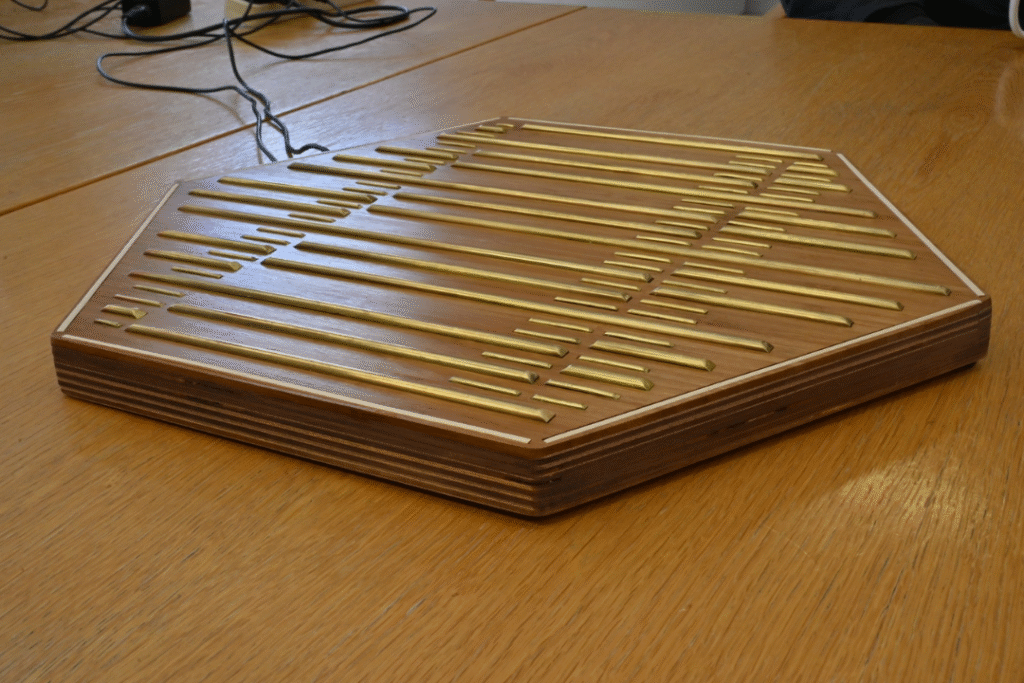
The result of the project is the ‘ReHarp’, which is made of a hexagonal wooden enclosure, with 78 small brass rods attached on top. The design means you can ‘strum’ to play chords or ‘tap’ to play melodies.
But how does it work? The instrument uses special technology which detects when the brass pieces are touched, and converts this into sound. It’s incredibly sensitive, meaning that people with limited finger movement or who find traditional instruments hard to play can still enjoy making music.
There’s no need to learn about musical notes or chords to play songs, as the edges of the instrument are colour-coded to help guide users. It’s battery powered and hospital-friendly as it fits on a standard-sized bed tray. It’s portability means it can be played with headphones or connected to a speaker, so it can be used in group settings, or quietly in a hospital bed without disturbing anyone nearby.
The ReHarp in music therapy
Before joining us at Nordoff and Robbins, our researcher Jacob was part of the original project that developed the ReHarp. Testing of the instrument was put on hold due to Covid-19, but now Jacob has been able to work with our music therapists to explore how the instrument can be used during music therapy.
Although the ReHarp is currently a one-off prototype, our music therapists have been able to use the instrument in a number of brain injury settings, and the feedback so far has been positive. One music therapist shared that the ReHarp is an easier instrument for clients to play, allowing them to create the harmony and establish the foundation of the music. They explained this is “less possible on guitar and piano where it’s harder for a client to happen upon the “right” chords to take on the role of the accompanist.”
And overall, our music therapists have found that the sensitivity of the instrument allows people to make loud sounds with only small movements, which helps to keep the music flowing during sessions.
A lot of clients engage with the ReHarp for longer than they do on other instruments – this seems to be because the sound is satisfying even with little movement. This helps to highlight what they can do musically and can give them a sense of achievement.
Nordoff and Robbins music therapist
The future
The ReHarp is an encouraging example of how technology in music-making can support recovery, whilst keeping creativity at the centre. Our research team will continue working with music therapists to explore how the instrument can provide support in brain injury settings. There are some challenges ahead, as making the instrument is challenging and requires specialist equipment. However, our research team are hopeful that collaboration with universities or specialist workshops in the future will allow development of the ReHarp to continue.
Latest posts
Can social prescribing support mental health?
How can social prescribing support mental health? Rosie shares her experience of music therapy as a form of social prescribing.
Can technology make music more accessible?
The ‘ReHarp’, a digital instrument designed to support rehabilitation following a stroke or brain injury, is showing how innovation can make music more inclusive, and allow creativity and expression to become a part of recovery.